The Green Iron Principles
The Green Hydrogen Organisation (GH2) launched the Green Iron Principles at COP30 in Belém. By defining what truly fossil-free, climate-aligned iron production looks like, the Principles were designed to bring clarity, credibility and global coherence to one of the most important industrial transitions.
The Green Iron Principles establish that green iron is iron produced with renewable energy and green hydrogen. They exclude the use of fossil fuels in every part of the production process. They also ensure that green iron is produced using high environmental, social and governance (ESG) standards, addressing both climate and broader sustainability expectations.
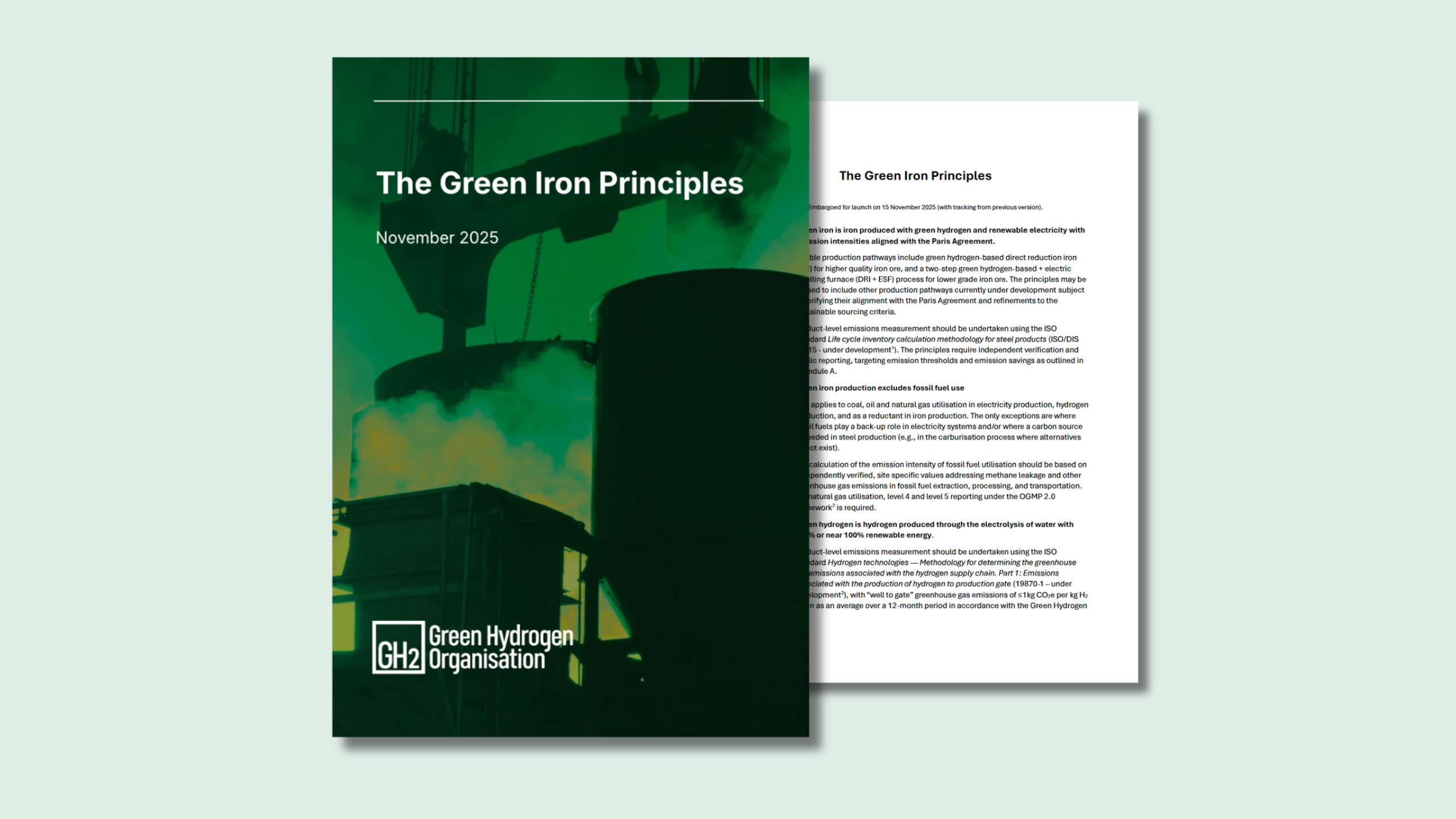
Read the full version of The Green Iron Principles here.
Find the official press release here.
Frequently Asked Questions
1. Why do we need the Green Iron Principles?
Global steel emissions have continued to rise over the past decade. The technologies to produce low-emission iron already exist, but deployment is limited to small pilot and demonstration projects. The Green Iron Principles provide a common, credible definition of green iron — helping governments, investors, and producers align around what truly qualifies as low-carbon, Paris-aligned green iron production.
2. There are so many steel standards – why do we need another one? What problem are the Principles solving?
Currently, there is no globally recognised definition of “green iron.” A range of overlapping standards describe “low-carbon” or “green” steel but stop short of setting clear emission thresholds or wider sustainability requirements. This creates confusion, inconsistent claims, and greenwashing risks. The Green Iron Principles close this gap by defining measurable, verifiable criteria for green iron production.
The principles complement and build on previous work by the World Steel Associationi, the International Organization for Standardization (ISO), the International Energy Agency (IEA), the World Trade Organization (WTO), and the Rocky Mountain Institute (RMI). They complement the work being undertaken by the First Movers Coalition, the Low Emission Steel Standard, ResponsibleSteel, SteelZero and others.
3. How do the Principles help accelerate decarbonisation?
Clear definitions and thresholds are essential for scaling investment and trade in low-emission materials. The Principles enable governments to design incentives and standards, financiers to set eligibility criteria, and producers to plan projects with confidence. They also help downstream buyers identify credible “green” products.
4. Who developed the Green Iron Principles?
The Principles were developed by the Green Hydrogen Organisation (GH2) with input from industry, academia and civil society organisations. We received over 20 submissions, including detailed feedback from Agora, ANU, Bellona and ECF, E+, Fortescue, IEFFA, OECD, Mission Possible Partnership, SteelWatch, Systemiq, Superpower Institute, Responsible Steel, RMI, the World Steel Association and WWF. There are divergent views on several key points, but overall strong support for progressing this work.
5. What is the definition of “green iron”?
Green iron is iron produced with green hydrogen and renewable electricity, achieving emission intensities consistent with the Paris Agreement. It includes production through:
Hydrogen-based direct reduction (H₂-DRI) for high-grade ores; and
Hydrogen-based direct reduction plus electric smelting (H₂-DRI + ESF) for lower-grade ores.
Product-level emissions measurement should be undertaken using the ISO standard Life cycle inventory calculation methodology for steel products (ISO/DIS 20915). The principles require independent verification and public reporting, which is not a requirement under ISO.
Future versions of the Principles may include other production pathways, including electrolytic ironmaking (molten oxide electrolysis and / or electrolysis of iron ore slurry), biomass-based reduction using sustainably sourced biocarbon (charcoal/biomass) instead of fossil coke in blast furnaces or DRI plants, electrowinning, and hydrogen plasma smelting reduction.
6. Why two different pathways with different thresholds?
Because both production pathways are needed – and have fundamentally different characteristics. The one-step green hydrogen-based DRI process has the lowest emission intensity, but there is (at present) insufficient high grade iron ore and scrap steel supply to meet total steel demand. Several countries and companies are therefore pursuing a two-step green hydrogen-based DRI + ESF process using lower grade iron ore. This has higher emissions, but also higher emissions savings compared to the counter-factual of using this ore in a conventional blast furnace (BF) process. GH2 is exploring the feasibility of an iron ore quality-variable scale.
7. Why are fossil fuels (coal, oil and natural gas) excluded?
To qualify as green, iron production must exclude coal, oil and natural gas utilisation in electricity production, hydrogen production, and as a reductant in iron production. The only exceptions are where fossil fuels play a back-up role in electricity systems and/or where a carbon source is needed in steel production (e.g., in the carburisation process where alternatives do not exist).
The use of coal, oil and natural gas deepens fossil fuel dependence. Genuinely green iron production pathways offer the best long term prospects.
8. What counts as “green hydrogen” under the Principles?
Green hydrogen must be produced by electrolysis of water using 100% or near-100% renewable energy, with verified life-cycle emissions of ≤ 1 kg CO₂e per kg H₂ (on a 12-month average). These requirements follow the Green Hydrogen Standard using the ISO’s draft methodology for hydrogen emissions accounting.
9. How is renewable electricity defined and verified?
Renewable electricity must come from sustainable sources such as hydropower, wind, solar, geothermal, biomass*, or ocean energy. Producers can count grid electricity as renewable only if they have power purchase agreements (PPAs) backed by credible Energy Attribute Certificates (EACs) or similar instruments. Certification must provide transparency on time matching, market correlation, and source location in line with global best practice, including the Greenhouse Gas Protocol Scope 2 Guidance (see below).
Where biomass and/or biomass waste is utilized, the project operator must demonstrate that there is a low risk of indirect land use change, including verifying that production of feedstock does not take place on land with high biodiversity, that land with a high amount of carbon has not been converted for feedstock production.
10. Why is nuclear power excluded?
As in the EU Renewable Energy Directive, we do not include nuclear energy in our definition of "renewable electricity" (which is typically treated as having zero emissions). However, we note that some countries have determined that there is a role for nuclear energy to accelerate the shift from more polluting activities, such as coal generation. Nuclear power raises some specific environmental and safety related issues which the Principles are not designed to address. If nuclear energy is used as an electricity source, the emissions accounting follows ISO and GHGP standards.
11. What does adherence to the Greenhouse Gas Protocol Scope 2 Guidance require?
The principles reference the Greenhouse Gas Protocol Scope 2 Guidance which requires companies to report emissions from purchased electricity, heat, steam and cooling using both a location-based method (reflecting grid-average emissions) and a market-based method (reflecting contractual procurement choices, such as renewable energy certificates or PPAs). It also sets quality criteria for energy procurement instruments to ensure that market-based claims accurately represent real emissions reductions.
The Guidance is current under review. The review is expected to include changes to the location-based method (e.g., updated emission factor hierarchy, requirement to use the most precise emission factors accessible, a new definition of accessible data) and market-based method (e.g., hourly matching requirement, deliverability requirement, new emission factor requirements) to improve accuracy, transparency and comparability. The proposed revisions include several measures to improve the implementation feasibility of the updates (e.g., load profiles for hourly matching, exemption thresholds to hourly matching for smaller organizations, a legacy clause for existing contracts, and a multiyear phased implementation).
12. How are emissions measured and verified?
Emissions must be measured at the product level using ISO’s Life Cycle Inventory Methodology for Steel Products (ISO/DIS 20915) and verified independently. This ensures that emission intensity data are accurate, transparent, and comparable across producers.
13. Do the Principles address social and environmental impacts?
Yes. Beyond emissions, the Principles require producers to assess the environmental, social and governance (ESG) impacts of green iron projects. This includes land and water management, community consultation, health and safety, and human rights — aligned with the ResponsibleSteel and the Green Hydrogen Standard. Learn more about the GHS here.
14. What role does transparency play in certification?
Green iron certification schemes must meet the highest standards of transparency and accountability. Those using mass balance or book-and-claim models must disclose their chain-of-custody approach, use blockchain or traceability systems, and undergo third-party audits to verify all data and transactions to ensure no “double counting” of emission reduction claims.
15. How do the Principles treat natural gas emissions accounting?
Where natural gas use plays a minor or backup role, its emissions must be calculated using independently verified, site-specific data that address methane leakage and other greenhouse gases — not default or generic emission factors — following OGMP 2.0 level 4–5 reporting.
16. How will the Principles evolve?
The Principles will be reviewed and updated annually to reflect technological progress, new data, and emerging international standards such as ISO and the Greenhouse Gas Protocol updates. Future versions may include new pathways such as electrolytic ironmaking or sustainably sourced biomass reduction.
17. What are the next steps for implementation?
The next phase involves:
- Validating the emission thresholds proposed in Schedule A;
- Engaging governments and standard bodies to align definitions and certification systems; and
- Supporting producers and buyers in applying the Principles in project development and procurement.
18. How can stakeholders get involved?
GH2 is forming a reference group which will meet quarterly to review progress and possible amendments to the Principles. To get involved, contact Sam Bartlett at sam.bartlett@gh2.org